


To have taste meant you’d done the slow, unglamorous work of developing a sensibility—years of looking, collecting, discarding, being wrong, being right, being embarrassed by what you used to think was good. It meant you’d sat in enough rooms, listened to enough music, and held enough objects to have developed something like a consistent inner logic.
Now taste is a fuzzy category. A term people default to when they want to sound like they’re saying something without quite saying it—like it’s something you can summon on demand, dial up when needed, conjure because you’ve seen enough mood boards. It gets invoked so freely and so confidently that I’ve stopped using the word altogether (yet here I am).
Thanks to the internets, we can see every archive, every collection, every reference. This makes it so that everyone’s super well-referenced but oddly untethered. AI made it worse, or maybe just more visible. Pattern recognition at scale. Which raises the question nobody bothers to ask: can perfect pattern recognition and good taste be interchangeable? Hardly. But this essay isn’t really about AI—it’s about anyone who wants the fruit without the labor. An LLM can give you the recipe. It can’t taste the final product.
Susan Sontag—essayist and unlikely patron saint of the aesthetics corner of YouTube—wrote in 1964 that taste has no system and no proofs—that the moment you can cram it into a system, it hardens into an idea, not a sensibility. She wrote that before the web, and long before Sam Altman was born. So what is it, then? Not a checklist. Not a ranking system. Not the ability to identify the right references. Something closer to a set of instincts you develop by paying sustained, honest attention to the world and then living with what that attention reveals about you.
The grey areas are where taste truly lives. Pattern recognition gets you surprisingly far… further than most people admit. Yet it has no values, and that’s its limitation. It can’t feel the difference between restraint and timidity, between confidence and arrogance, between cohesion and repetition. Those distinctions are learned slowly. Usually through error. Usually through making something that looked right on paper and felt wrong in the real world. Through buying the thing you were supposed to want and noticing, six months later, that you never reach for it. Through watching someone you respect make a decision that surprised you and sitting with why it worked. I’m not trying to make a romantic argument for struggle. It’s just an accurate description of how the thing develops.
There’s a version of taste that’s purely defensive. A set of rules you follow to avoid being caught out. Never mix metals. Always buy the best you can afford. Less is more. These aren’t wrong exactly. They’re just the floor. Someone who follows rules is outsourcing judgment to a consensus someone else formed; it’s not exercising taste. The truth is, developed taste can land somewhere genuinely good or genuinely bad—but the person who’s arrived at bad taste through real effort is harder to argue with than the person who just never thought about it.
Good taste involves knowing when to break the thing you know. When more is more. When the obvious choice is a trap and when the weird one is true. You can only make those calls if you’ve developed an inner standard that you actually trust and one that hasn’t been borrowed from somewhere else. That inner standard takes time. It’s built from specific encounters, and you can’t shortcut those encounters.
Most people develop taste unevenly and don’t realize it. The person with an extraordinary eye for visual things who has no instinct for when to stop talking. Or the person whose work is refined and whose relationships are chaotic for the same underlying reason—they’ve never applied the same standards inward. Sontag noticed this too. She said taste tends to develop very unevenly—that it’s rare to find someone with good visual taste and good taste in people and good taste in ideas. Most of us have a dominant channel and a blind spot we’ve made peace with. Usually the weaker area is where you haven’t done the looking yet.
There’s a genuine connection between taste and character, but in a practical sense. Like how a good eye and a steady hand are quietly linked. When you know what you value, your decisions get cleaner. Fewer compromises. Less justification after the fact. What emerges is coherence—a level above consistency. You can feel it in someone’s choices without being able to name the source. That quality takes years and it can’t be prompted.
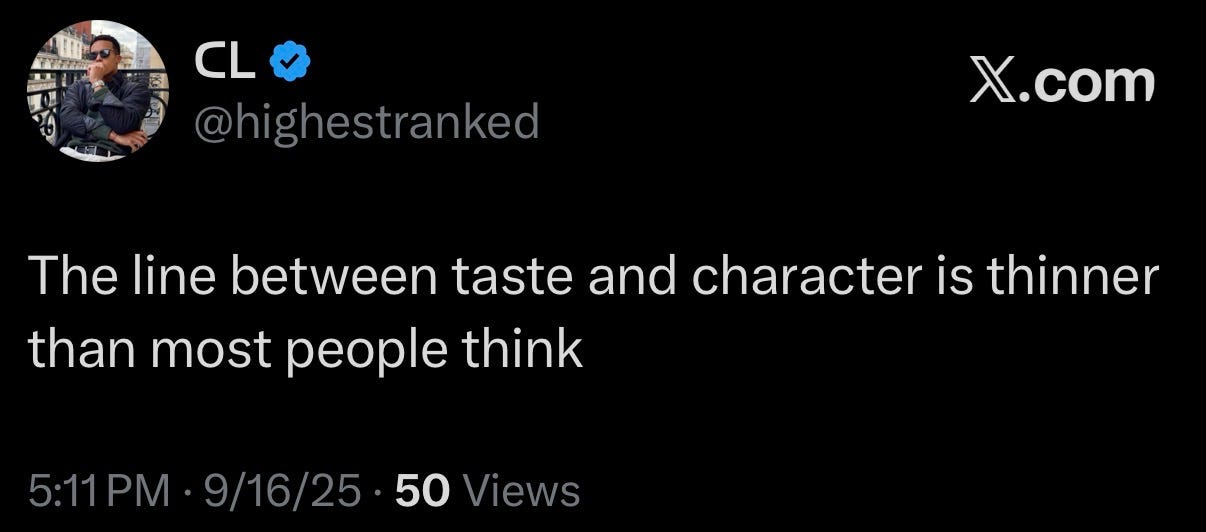
There’s something worth saying about restraint specifically, because it’s the quality most often faked and least often understood. Restraint isn’t minimalism. It isn’t removing things because removing things is the move right now. It’s knowing what the thing needs and having the confidence to stop there. That requires a very clear sense of what the thing is trying to do, which requires values, which requires knowing what you actually believe (and not what you’re supposed to believe).
Taste isn’t a fixed setting. What’s right shifts with the situation, the audience, the stakes, the history of the thing. Someone with genuine taste reads context continuously and adjusts—not to please, but because they understand that the same choice lands differently depending on everything surrounding it. A word that’s perfect in one sentence ruins another. An object that belongs in one space looks desperate in a different one.
This is why taste in objects eventually connects to taste in behavior or in conversation. The same instincts apply. You’re always asking: what does this moment need? What’s too much? What’s missing? Taste is a practice. It requires genuine attention, sustained over time, applied honestly. It requires living with your choices long enough to learn from them. It requires caring enough about the quality of your perception to keep refining it even when no one’s watching and there’s nothing to signal.
The references matter less than the attention. The archive matters less than what you do after you close it. Knowing the right names is only the beginning of the conversation. Taste is what happens after you’ve done all that and let it settle. It can’t be downloaded. It can’t be prompted. It can’t be claimed before it’s earned. But it compounds. Every good decision makes the next one slightly easier to see. Every honest encounter with quality raises the floor of what you’ll accept. Every moment of real attention leaves a trace.
Attention is all you need.